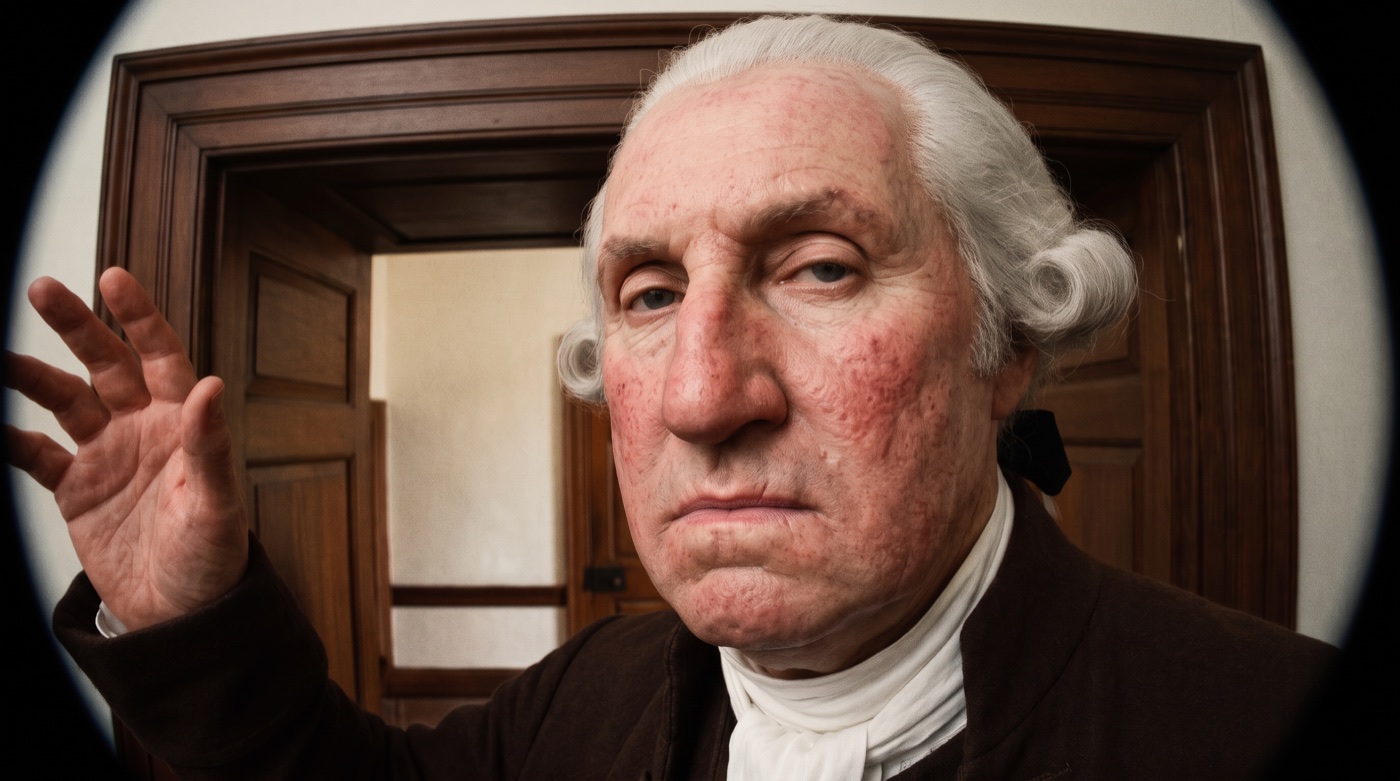
The step-by-step method behind the George Washington vlogs: one face, one voice, one very serious man filming his own day at Mount Vernon and correcting every myth you learned in school. All the prompts, the references and the mistakes, so you can build a historical character of your own from scratch.
He doesn't recite his biography. He films his day: the long porch over the Potomac, a closed box on his desk, the green dining room by candlelight. The history is real and checked; the phone is the only thing that isn't.
36 pages, twelve chapters in the order you'll actually work, plus an appendix of templates. Written for complete beginners, and it works for any real person whose daily life was strange and well recorded.
The format in one sentence, why people watch to the end, and the three things every episode delivers.
School myths, the farm he really ran, ideas ranked by views per day, and a fact sheet for every claim.
The face I threw away, the real feature worth exaggerating, two reference formats and the mouth rule.
The personality and voice blocks pasted into every scene, how he gets a laugh, and his recurring lines.
Rotating rooms, angles and clothes, writing the real Mount Vernon, and who else appears on screen.
The myth in the first line, formal without sounding robotic, timing for a slow speaker, words that cause trouble.
Fixed blocks and the two you write per scene, a complete real scene, and where each rule came from.
Seedance 2.5 on Higgsfield, the settings, why there are no drafts, and war stories past the content filter.
Frame grids at two per second, transcript against script, a pitch check for his voice, cut or remake.
Cut lists, loudness, subtitles for Shorts, and why long episodes carry no text on screen.
Titles that contradict what people believe, and the selfie-with-evidence thumbnail.
Credits per take and per episode from the first Short, a budget for long episodes, and your first week.
The video model remembers nothing between takes, so every prompt carries the whole man. Most blocks never change; for each scene you only write where he is and what happens, second by second.
9:16, a raw front-camera selfie from 1794, one unbroken take, the phone never seen, no text, no music…His face from the reference only: the heavy ruddy face, the large nose, the swollen mouth pushed forward by his false teeth. Lips pressed together when he isn't speaking…His study at Mount Vernon. On the desk, from the very start, a small closed wooden box with a brass clasp…10–17 s: he looks straight into the lens, very serious: "Hippopotamus ivory. Cow teeth. Brass screws. And a base of lead."…His teeth are never shown. Objects never float or turn into other objects. The whole shot stays in this one place…Real clips from the first George Short, "My Teeth Are Not Wood", untouched. Tap Sound to hear him. Each Short is five scenes of 25 to 30 seconds, one take each.
Each episode settles an argument people have had since grade school. The guide shows you how to find those myths for any character, and how to check every fact.
Hippopotamus ivory, animal teeth, brass screws and a base of lead. Not one splinter.
Invented by his first popular biographer, years after he died.
His own reddish-brown hair, powdered white.
It starts from zero and names every tool in plain English.
Build a channel around a character instead of yourself, on YouTube, TikTok or Instagram.
Turn the stories you already know into short vlogs people watch to the last second.
Never opened an AI video tool? The first-week plan tells you what to do each day.
“Good morning, my fellow citizens.” One guide, one price. Download it, follow the first-week plan, and post your first episode within seven days.
No. It's written for people who have never made an AI video. Every step says what to open, what to paste and what to check.
Yes. George is the example from start to finish, but the method fits any real person whose daily life is well documented.
An image model for the face reference, Seedance 2.5 on Higgsfield for the scenes (face, voice, sound and movement in one take) and any video editor. Chapter 12 shows the real credit costs before you spend anything.
Both: vertical Shorts with subtitles, and 16:9 episodes of eight to ten minutes told as one story.
The download page for the PDF opens right after payment.